Free excerpt from The Warm Intro Raise Kit
Ask the connector, not the angel
How the double opt-in intro works, and the short email that makes it easy. A free excerpt from the Warm Intro Raise Kit, by Don Smith, Tanager Holdings.
Most angels decide whether to take a first meeting based on who sent you. Not the deck, not the market size. Who sent you.
That makes a pre-seed raise from angels mostly a trust-transfer problem. Someone the angel already trusts has to vouch for you. Your job is to find that person, make it easy for them to say a few good words, and then not waste the meeting they got you.
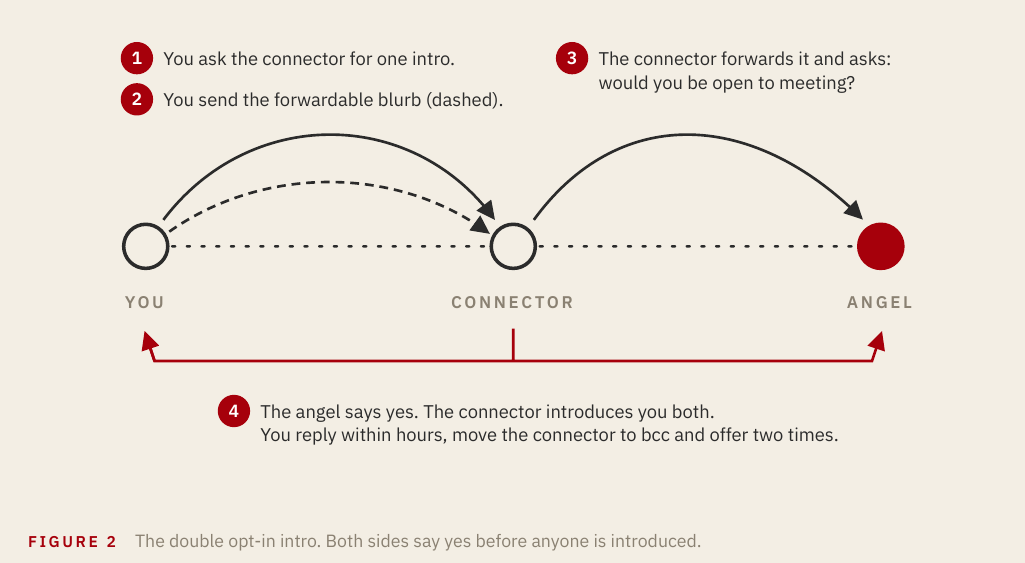
The standard, polite way to do that is the double opt-in intro. It’s called double opt-in because both sides say yes before anyone is introduced. It protects your connector’s relationship, which is the whole point, and it shows respect for their time.
The four steps
- You ask the connector. Short, specific and easy to say no to.
- You send a forwardable blurb. A separate, short email the connector can forward without editing a word.
- The connector asks the angel. Usually they forward your blurb with one line of their own: “Would you be open to meeting this founder?”
- If the angel says yes, the connector introduces you both. You reply within a few hours, move the connector to bcc, and offer two times.
Why it matters
An angel who agreed to the intro shows up curious. An angel who was surprised by it shows up annoyed, and your connector pays for it.
Think about it from the connector’s side. Their relationship with this angel took years to build, and you’re asking them to spend a little of it on you. If they copy you both on an email out of the blue, they’ve put the angel on the spot. Say no and it’s awkward. Say yes and it’s a meeting they didn’t choose. Either way, the connector is less likely to forward the next founder, including you.
Double opt-in takes the pressure off everyone. The angel can pass quietly. The connector risks nothing. And when the angel does say yes, you start the meeting with someone who wants to be there.
How to ask
Your first ask in a raise is almost never to an investor. It’s to the person who knows one. A few rules:
- Ask for one intro at a time, to one named person, with a one-line reason.
- Give the connector an easy out: “If it’s not a fit or not a good time, no problem at all.”
- Never ask a connector to pitch for you. Ask them to forward your note.
- Thank them twice: once when they agree, and again when something comes of it (or doesn’t).
The ask itself can be four sentences. Who you want to meet, why that person, what you’re building in one line, and the easy out.
The forwardable blurb
This is the most important email in a warm-intro raise, and most founders never write one. It’s the note your connector forwards to the angel. It has to stand on its own, because the angel may read nothing else.
Five sentences, in this order:
- What the company does, and for whom.
- The proof. One or two facts that are true and checkable. At pre-seed this is often market research: who you talked to and what they told you.
- Who you are and why you’re the right person to build it.
- The raise basics, only as approved by your counsel.
- The ask: “Would you be open to a 20-minute call?”
Here is an example. The company, the people and the numbers are made up.
Subject: Intro: Ledgerline, payroll checks for small clinics
Ledgerline catches payroll errors for independent dental and vet clinics before payday. Before writing any code, we interviewed 12 clinic owners and office managers, and 9 of them said fixing payroll mistakes eats hours every month. I’m Jordan Reyes. I ran payroll operations for a 60-location clinic group for six years before starting Ledgerline. We’re raising $400K on a SAFE to hire two engineers and reach 100 paying clinics. Would Pat be open to a 20-minute call next week? Happy to send a short deck first.
Aim for 80 to 130 words. If your connector has to scroll, it’s too long.
What to leave out: adjective stacks (“innovative, scalable, disruptive”), market size in sentence form (“a $40B market”), projections stated as facts, and anything you’d be uncomfortable seeing forwarded to a stranger. It will be forwarded. That’s the point.
No attachments. Offer the deck on request.
Test it
Forward your blurb to a friend who doesn’t know your business and ask two questions: what does the company do, and what are you asking for? If they get both right in 30 seconds, it’s ready.
The rest of the raise
The intro gets you a meeting. It doesn’t get you a check. You still need a list worth working, a clear map of who can introduce you to whom, a first meeting that doesn’t waste the angel’s time, and follow-up that doesn’t read like a reminder that nothing changed.
We wrote all of that down in the Warm Intro Raise Kit: a 19-page playbook, an investor tracker, 28 message templates and 12 AI prompts. If this excerpt was useful, the full kit is here: tanagerdon.gumroad.com/l/zhsiqt
The kit's page on this site: The Warm Intro Raise Kit.
Share your story
Did these methods help you raise?
Tell us how. What worked, what didn't, and what you'd change. Email don@tanager.holdings with the subject 'My raise story'.
We'll ask before we share or quote anyone's story.
This is general information for founders, not legal, tax or investment advice. Don Smith is a former attorney and is not practicing law. Talk to your own securities counsel before you send anything to an investor. Nothing here is an offer to sell or a solicitation of an offer to buy any security.